13: Tax Free Savings Accounts (TFSAs)
I’m old enough to remember when Tax Free Savings Accounts were invented, and was actually (for my sins), still working in banking at the time.
Back then, no one really knew what to do with their $5,000 in contribution room, and most financial planners only had the faintest sense of how important this type of account would be.
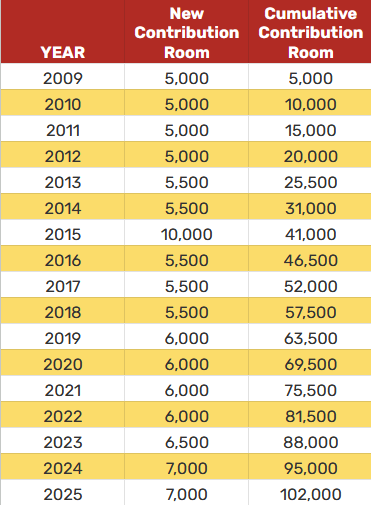
Fast forward to 2025, and almost everyone born before 1991 could (theoretically) contribute $102,000 to their TFSA this year, with another $7,000 in room opening up on January 1st of 2026.
Like a Registered Retirement Savings Plan, a Tax Free Savings Account isn’t a thing you buy; it’s a bucket that you open to put money into.
When money goes into that bucket, it magically becomes invisible to income tax and you can leave the money inside the bucket in a savings account, or buy Guaranteed Investment Certificants, stocks, mutual funds, bonds, and exchange traded funds.
But that’s about where the similarities between TFSAs and RRSPs end. If you have money to save, and don’t know where to save it, how a Tax Free Savings Account works might be a useful bit of information to have.
Who Can Open a TFSA?
Anyone who is a resident of Canada and is 18 or older can open a Tax Free Savings Account. That’s it, no other qualifications required.
How Much Can You Contribute to a TFSA?
When you contribute to your TFSA, you don’t get to deduct it from your income. It’s considered an “after-tax” contribution. In 2025, the dollar limit for TFSAs is $7,000, meaning that if you became a resident of Canada or turned 18 this year, you can contribute $7,000 to your new TFSA.
Every year on January 1st, a new dollar limit is announced. Because TFSA contribution room is tied to inflation, but only actually increases in $500 increments, we already know that on January 1st, 2026, the “new” dollar limit will be $7,000 again. So, if you became a resident of Canada or turned 18 this year, you could contribute $7,000 in 2025 and another $7,000 in 2026.
When you withdraw from your TFSA, you can contribute the same amount back again the next year. So, if you opened your first TFSA in 2025, contributed $7,000 in January and withdrew $500 from it in March, you have to wait until January 1st, 2026 to put that $500 back in the account, otherwise you’ll pay a penalty equal to 1% of that $500 overcontribution for every month you leave it in the account.
How Much More Can You, Specifically, Contribute to Your TFSA?
Yes, but what if you turned 18 a long time ago?
TFSA contribution room carries forward indefinitely, so if you, like me, turned 18 long before TFSAs were invented, and you’ve been a resident of Canada that whole time, you likely have lots of room available. But how much?
This should be a simple question to answer if you have a CRA account (if you don’t, head back to episode one and take a few minutes to get access to yours). Theoretically, you should be able to find your current TFSA contribution room by logging into your CRA account, scrolling about halfway down the page, and reading off your current year contribution room.
There are two problems with this approach: first, contribution room is only current as of the first of the year, so as of the time of this recording (in November of 2025), your contribution room is at least 11 months out of date.
Second, and more troubling, sometimes the CRA takes a very long time to actually calculate and post your TFSA contribution room. Financial institutions have until the last day of February to send your contribution and withdrawal history to the CRA, and this year it took them 5 months to finish the math and post the results. And sometimes those results were mistakes.
The fix, as they say, is to calculate your own room and keep your own math updated every time you add money to or subtract money from your account. The last thing you want is to overcontribute to your TFSA and start racking up penalties to the tune of 1% of your overcontribution amount for every month it stays in the account.
In 2025, anyone born in 1991 or earlier who has been a resident of Canada continuously since 2009 and has never contributed before can contribute $102,000 to a TFSA. Everyone else needs to use a calculator.
To find out how much you can contribute to your TFSA, you need five ingredients, only one of which I can give you (in the resources for this episode):
Your year of birth
Any period(s) of time since turning 18 that you were not a resident of Canada
Any contributions you’ve made to a TFSA
Any withdrawals you’ve made from a TFSA
TFSA contribution room, by year
Withdrawing From Your TFSA
You never have to withdraw from your TFSA if you don’t want to or don’t have to. If you decide that taking money from this account makes sense, you won’t pay any income tax at all on the withdrawal, even if you earned massive amounts of income on your investments - every penny is tax free.
And remember, you get that contribution room back the next year.
TFSAs at Death
When you die, your TFSA stops being a TFSA and the money goes (tax free) to the person you named on the account as the beneficiary. If the account earns any interest or investment income during the period between your death and when they receive the money, they have to pay tax on that income. If they have room in their own TFSA to contribute some or all of the money they received, they can do so, but they don’t get any more room of their own just because they’ve inherited your TFSA.
If the beneficiary is your spouse, or if you live in a province that allows you to name your spouse as a successor holder on the account itself, the account continues to be a TFSA and transfers to that person, without any tax. There might be some paperwork involved, but effectively your spouse has their own TFSA and yours, and all of it stays tax free.
Why is This Important?
If you’re in a position to put money away for the future, knowing the basics of Tax Free Savings Accounts and Registered Retirement Savings Plan can help you decide what kind of account makes the most sense…for you, specifically.